Monday, April 13, 2009

One Day (But not yet) We Will Also Be Labeled As, "The Older Generation"

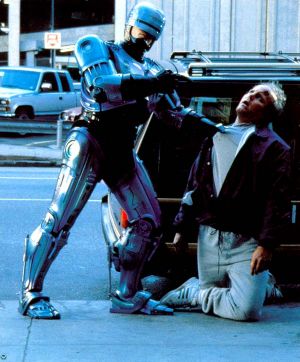
   Last Wednesday in class, I believe we all in agreement that although Robocop may have been ahead of its time, now-a-days its “special effects” left much to be desired. One of the first things that I noticed, was the original robot present to the police of Detroit. Its jerky motions made it very apparent to the viewer that it wasn’t really even moving, but rather its “movement” was provided by some clever editing. What was really comical, is that this particular film was set in the future, but was still rank with the eighties. A box television with dials was even present in one scene and the hair styles and clothing left little room to imagine this film taking place in any decade besides the one is was filmed in. So  much so that after the movie was over,  I even leaned over to a classmate  and asked if it was supposed to be set in the future. These dated, futuristic movies tend to leave one dazed and thrown-off course, but in the meantime, they also tend to offer some unintended comedy. (See the jerky movements mentioned above. I mean, come on ,that was funny.) Some This prompted me to start thinking, what other films are so obviously dated? What modern films will be laughed at in the future?

      The first one I could think of is one my Dad and brother are fans of: The original Star

 Wars trilogy (you know, the third through sixth, the old ones). These three films were also children of the eighties and the times definitely left there mark. Like Robocop, the Star Wars trilogy was intended to be futuristic, but now they simply leave the viewer a bit confused and maybe even a tiny bit lost in time. I think one of the main comedic situations in any one of these films has to be the somewhat stilted dialogue. However, I am not sure if this is due to when they were produced. (Perhaps it is due to the skill, or lack there of, of the actors.) But if you are watching with a quick and observant eye, you will undoubtedly find unintentional comedy. 

     Another film I just couldn’t resist comparing to Robocop was Back to the Future. Back to the Future was filmed in 1985, and while it was not necessarily filmed with the intention of making it look futuristic, there are some aspects of it that are intending to be a little modern. For instance, take a gander at the time machine the old professor is oh so proud of. Can you say dated? There is no way I would ever set foot in a time machine that looked as ancient as that. Then I have to remind myself that at that time, that car was hot stuff.

     I think that no matter what, we will always look back on movies that one point were at the height of technology and fashion and think, “Wow, that movie was ridiculous.” It is inevitable. Fortunately, it provides good comedic entertainment for later generations. 


Speaking of the older generations....sorry, couldn't resist. This was just funny. 

Wednesday, April 8, 2009

Robocop Does Not Equal Compassion

     Violence, gore, bad verses good—Robocop was chock full of these aspects. If you are in need of releasing a little pent up aggression via vicarious movie viewing, then Robocop is for you. Unfortunately, the bloody scenes were a bit much for me. I’m sure the people sitting behind me got a good laugh out of watching me cringe throughout the entire film. I have never been one who enjoys watching body parts get blown off every which way.  Even with this being true, I have grown up watching movies such as this, and continue to do so today.

     Granted they may not have the quite the amount of gore that Robocop does, but they come close: Gladiator, The Matrix Trilogy, the LOTR trilogy and several other “guy” movies are ones that I have seen over and over again. On one hand, this doesn’t make sense; I do not enjoy violence in movies (I’m not protesting it, I just don’t enjoy it). And yet I have a repertoire of these type of movies built up. I guess I can attribute it to my dad, brother, the mass of boys (my brother’s friends. He’s only a few years younger than me), and my guy friends. Oh well, I 

guess I enjoy the company. One thing I feel like I have gained due to this is a good comparison and knowledge of action type films.

     The major issue that really caught my eye in this week’s movie is the lack of restraint that not only the villains seemed to show, but Robocop and the “good guys” as well. Murder, whether a cop or a criminal, was no big deal. Granted, some of the villains that were killed did deserve to die but that is one of the huge differences between Robocop and modern day action flicks. Batman, Spiderman, Superman—rarely do you see these celebrated superheroes kill a single fly, much less a human. These guys are creative and skilled in what they do. They are always finding some way to rig up the criminal so that the cops can find him and haul him off to jail. To e, this is the way things should be. What justifies the killing? Who is are the Detroit police force or Robocop to make the decision to take human lives? This is one huge factor that in my book, denies Robocop of hero status. He may have a human heart, but in then end thanks to his lack of restraint and compassion, I can see no difference between his and the villain’s heart. 


http://www.reelfilm.com/images/robocop2.jpg

Tuesday, April 7, 2009

Theraputic Prescription Number One: Just Dance


     Last weeks movie, Saturday Night Fever, was all about the controversy of the fast lifestyle that Tony and his friends led. It showed pros (like sex) and the cons (like when Bobby C. falls off of the bridge and drowns). On the dance floor, Tony was unstoppable; he was in his element and king of the turf. However, at home, his life was another story. He was stuck always  being the second best compared to his older brother who was a priest. Tony never quite measured up to his parents’ expectations.


  Dancing, gangs, and rough home lives— all of these things are seen in yet another, more modern film, Step Up. Tyler Gage is a punk from the streets involved in all sorts of questionable activities such as stealing cars and breaking into buildings. He was caught breaking into an art school, and his punishment was in the form of working for the sch

ool. There, he was able to see

 another side of the dance scene. Whereas he had simply been a street and club dancer before, at the school Tyler was introduced to a new form of dancing while still being able to incorporate what he had learned on the streets. He began dedicating a lot of his time to practicing with Nora, a girl he had met and was interested in. This encouraged him to pursue a scholarship to the Maryland School of Arts. All the while, his friends were becoming more and more agitated with his lack of free time. His best friend, Mac, ends up becoming so angry that he will not speak to Tyler until Mac’s brother dies in a tragic shooting.

     Even though the situations were a bit different, I think Tony and Tyler are very similar. Both come from lower class backgrounds, both are fairly unmotivated until deaths of friends, and both use the dance floor as a relief from every day struggles.  It seems as if dancing offered therapeutic benefits for both—a dose of confidence and a boosting of the ego.

     Also, while watching Saturday Night Fever, I couldn’t help but think of a recent song that is currently being overplayed on Alice107.7: Just Dance, by Lady Gaga. The chorus in this song focuses on the words, “Just dance, it’ll be okay.” It reminded me of Tony’s mindset throughout most of the movie. Once he got out there and started dancing, that was all that mattered. No family problems or work problems got in the 

way. When he was dancing, everything was okay. It was his relief from real life. 


http://www.worldofkitsch.com/film/images/film_snf003.jpg

http://z.about.com/d/movies/1/0/d/u/M/stepuppubc.jpg

http://joyhog.com/wp-content/uploads/2008/11/lady_gaga_the_fame-11.jpg

Thursday, April 2, 2009

Skeletons in the Closet

      So from what I can tell, this is the “bare your musical skeletons” journal.  This is where I get to say, “I listen to this, but its ok because…” and then proceed to explain poor musical taste and choices. We all have these whether we care to share them or not, and we all are willing to laugh at ourselves and quickly explain away and defend the musical faux pas that appears in our Itunes playlist. They may be embarrassing and inconvenient, but these songs are close to our heart for many reasons, and will not be easily given up. They are embedded in us, in our friends, and in our lifestyle.

      Before writing this, I scanned through my playlists and was quickly able to identify a few of my own skeletons such as “I Wanna Dance With Somebody” by Whitney Houston and “I’ve Had the Time of My Life” by Bill Medley and Jennifer  Warnes

(Yes, I am aware that this is perhaps the cheesiest and most overdone song ever).  I am embarrassed to say that I not only listen to these corny products of the eighties, but that I also

 enjoy them. Picture it: girls in their pajamas, dancing around the room, screaming these songs at the top of their lungs. (Yeah, most of us do not outgrow this when we enter college. It typically takes a little longer. Sorry guys.) These two songs are ideal for this type of activity and I think have become “classics” in their own, small way. I will be the first to say that they are far from musical masterpieces, but it has been twenty years and they have not faded into obscurity yet.

     Everyone has their secret likes and dislikes in the music area. Whether you listen to love ballads, eighties music, or screamo, you do it because it is enjoyable and because in some way or another, it expresses something about yourself. Is that not what music is for—our enjoyment and expression? I am not a connoisseur of eighties music—far from it—but I do enjoy these two particular songs (and perhaps a few others).  My taste in music ranges from Amos Lee and Ben Harper to Avril Lavigne and I Nine and I am currently listening to The Police. (Whoops, just gave away another eighties pleasure)Even though it’s eclectic, I do not feel as if my taste needs or requires an explanation. It is what it is. 


http://www.clker.com/cliparts/2/e/8/8/1194986685743465171musical_note_2_dennis_bo_01.svg.hi.png

Sunday, March 29, 2009

To Be Good or Not To Be Good?


The character, Shaft, was your typical bad, good guy. He was rough, tough, and impenetrable, but for good. He was not a “hero” or someone that a mother would be comfortable leaving her children with, but ultimately, he was good—he did do the right thing. I think a lot of times we look up to and admire characters like this; characters who have enough backbone to deviate and to cause a little trouble, but are still good enough at heart to ultimately do the right thing. Pop culture thinks it is cool to be bad, but not too bad.
Take the character of the Joker from The Dark Knight. Yes, he’s cool, but in the end, doesn’t he become more of a pitiful object than a cool one? He has no admirable actions, accomplishes no ultimate good, and simply works for his own benefit. When it comes down to it, the Joker is just plain sad. He has no friends, no family, and no one to love or be loved by. I do not see how anyone could aspire to accomplish what the Joker accomplished. Yes, he had money but that meant nothing to him. He burned a huge pyramid of cash—money meant that little to him. The Joker lived a life without meaning and without purpose.
On the other side of things, there’s Batman. At first glance he may not be the coolest character—he could be seen as “too good,” too self-righteous. Who is he to take the law into his own hands? But after a closer look at things, Batman has a dark side and he has struggles. His parents died when he was young and the only woman he has ever truly loved dies. The movie is called “The Dark Knight” for a reason, the whole attitude of the movie and its hero is encased in darkness. Batman’s entire being is struggling with good and bad, right and wrong throughout the entire movie. He is cool, because he is not perfect but ultimately does make the right decisions.
Shaft and Batman both have dark sides but both of them end up working for good. Maybe their means are not always ethical, and they do make wrong decisions. I think that’s part of their cool factor—they are human and they are real. Most viewers are able to relate to them and to their struggles to some degree. Being able to relate is cool.


Thursday, March 19, 2009

Pulled In Two Directions


Racism—not an issue that was directly addressed in the movie Shaft, but definitely an ever-present, underlying theme. Several instances and situations really stood out to me: Shaft’s “white man’s” job and “black man’s” attitude, his witty white jokes, and the conflict between the white mob and the black gang were just a few of them. I took Adam Frank’s class on race for Honors Core III, and since then, I’ve been more sensitive to things such as racial jokes and issues—perhaps too sensitive. Nevertheless, that is where my mind went when watching this film.

The main issue, I believe, was that Shaft was continually trying to bridge the gap between his profession and his culture. His coworkers never seemed to be able to trust him. They continually doubted his motives. It seemed like his “brothers” considered him a traitor, and were also unsure of Shaft’s intentions. This was made excruciatingly apparent when in response to something Ben says, Shaft replies, “I ain’t no Judas.” It seemed as if Shaft was considered too “white” for the black gangs to trust, and too “black” for the majority of his coworkers. However, there was one specific interaction with his friend on the police force, Lt. Victor Androzzi. Androzzi tells Shaft that he “is not so black” while holding a black pen to Shaft’s face. Shaft replies with, “You aren’t so white yourself,” and holds a white mug to Androzzi’s face. To me, this was an obvious racial relations situation that was placed in the film to make a statement. Perhaps that we are less of what we think we are and more similar to what we think we are not. That the two colors—black and white—in mankind, are more similar rather than opposites.

Another thing that really stood out to me, was how Shaft was continually making white jokes, especially towards his white coworkers. Granted, they were funny, but I did wonder what the motives or thought processes were behind them. I came up with one solution: he was trying to separate himself. He wanted to differentiate between himself and the white men he worked with. Maybe this was a result of the outcast he had become in the parts of the black society, maybe not. Perhaps Shaft simply desired to be known as separate—as an entity set apart. I believe he attained that. Shaft did distance himself from both “sides”—white and black—but in doing so, I believe he gained respect from both also.

Saturday, March 14, 2009

A Hippie Kind of Cool


As we watched this week’s film, Easy Rider, there was one particular movie and one particular band that kept coming to mind. Across the Universe was released in 2007, but was based during the same time period of Easy Rider—the late 1960s. Across the Universe is a film based entirely on music by the Beatles. Its story is told through the use of many songs by the Beatles and by members of the Beatles. The film begins showing a young man, Jude, in Liverpool, England. Jude travels to the United States to find his father, who is working on Princeton’s janitorial staff. There, Jude meets Max, the son of a wealthy American family. Jude goes home with Max for Thanksgiving and meets Lucy, Max’s sister. Not long after that, Max drops out of school and he and Jude head to New York City. They find a small apartment to live in. There, they meet Sadie, their landlady who is trying to make it as a singer; Prudence, a young woman who has hitchhiked from Dayton, Ohio; and Jojo, a guitarist. Once Lucy’s boyfriend is killed in Vietnam, she also heads to New York to live with Max and Jude.


This movie is all about the convergence of different people with different lifestyles. The film is laced with references and representatives of huge 1960s icon such as when Ken Kesey and his Electric Kool-Aid make an appearance while Sadie and Jojo are meeting with a prospective manager for their band. There is also a huge “trip” when the group of friends jump into this psychedelic van name “Beyond” and head to an unknown destination. Presumably, they are all on LSD and there is period in the movie where, as a viewer, I was completely thrown off and confused (very similar to how I felt during Easy Rider’s trip scene). What amazes me, is that Easy Rider was filmed during the prime of this counter culture , while Across the Universe was filmed almost forty years later yet I feel like it was pretty much dead-on in its representation of that time period and counter culture. This opinion is only reinforced after watching Easy Rider.


However, I do think the two films had two different purposes. Easy Rider was filmed to bring recognition to the cool aspect of this counter culture and perhaps to combat prejudices that accompanied that lifestyle. It showed the way outsiders viewed Wyatt and Billie and the disapproval and hate their lifestyle brought upon them. While Across the Universe shows the turmoil within that particular counter culture—war protests, the breaking up of families, and the consequences of their actions and decisions; but it was also produced to bring about recognition of that time period as a whole, with emphasis on one particular counter culture of that time. I think it does a good job of showing both the cool and the not-so-cool aspects of the hippie and anti-war era. Since the release of that movie (and perhaps because of it), a new generation of Beatle’s fans has sprung up. The Beatles and the peace sign had always been around, but this film gave my generation a better idea of the feeling and passion behind both of those icons.